Image | AI-generated
The End of Ghost Town Booths Part 2: Why the €50,000 Feature Museum Vanishes into Thin Air
Trade show season is back. The halls are booked, the booth builders have delivered, the polished machines and software terminals are ready. Germany’s tech mid-market is rolling out the heavy artillery. But anyone strolling through the aisles of major B2B trade fairs witnesses the same paradoxical and, above all, expensive spectacle among many exhibitors over and over again.
The core problem: Engineers build world-class technology, but at trade shows, they often only present “features”.
The Diagnosis: Trapped in Your Own Museum
When the focus lies purely on technical specifications, the technology remains trapped in a “museum”. Potential customers — trade visitors who are actually looking for concrete solutions to their acute operational problems — simply walk past the mute exhibits.
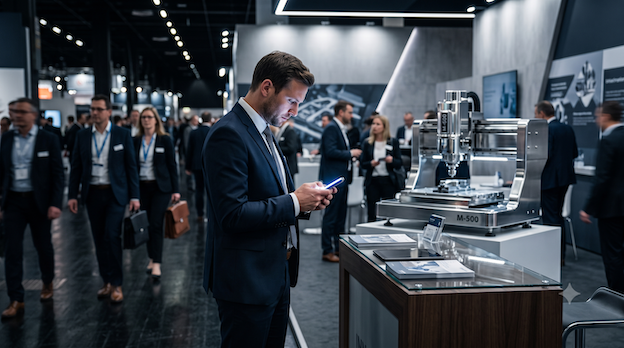
The result is devastating for the motivation of your own team. When the response fails to materialize, booth staff quickly lose themselves in “smartphone mode” out of sheer uncertainty. People would rather check their emails than subject themselves to the frustrating feeling of being ignored by passers-by.
At the end of grueling trade show days, the bitter financial reality is printed out in the controlling department: A €50,000 investment stands against 100 worthless business cards. The ambitious trade show appearance has turned into an expensive ghost town.
The Thesis: Technology Needs a Structural Messaging Foundation
Why do these trade show appearances fail? Not because of the budget, not because of the booth design, and certainly not because of the quality of the products. They fail due to a lack of translation of their own excellence.
It is time we break the silence of the hidden champions. The illusion that good technology “speaks for itself” is exactly that: an illusion. Technology needs a solid foundation, a resilient “structural messaging architecture”.
We must begin to consistently “interpret” this technology. In practice, this means a radical shift in perspective: Away from the feature list, towards customer-centric problem solving. Only if we build the message to be this stable will it not topple over in the loud, confusing noise of the trade fair.
A successful booth requires you to translate your technical excellence into a razor-sharp message and stage it at the booth in such a way that it captivates customers.
In the third part of this series, I will show you exactly how to translate your core message and put it through a “stress test” so that trade show visitors have no choice but to stop at your booth.