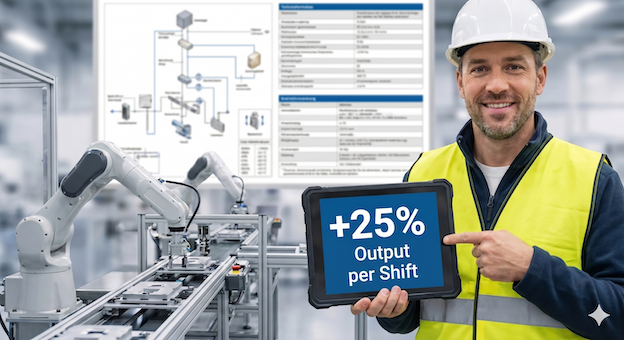
The Translation Workshop Part 2: The Data Sheet Dilemma – Why Technical Data Are Not Sales Arguments
Engineers love details. They are proud of cycle times, torques, efficiency levels, and tolerances that lie beyond the imaginable. And that is a good thing, because these details determine quality. But when it comes to marketing, exactly these data sheets very often become a stumbling block. Welcome to the data sheet dilemma: you provide facts, while the customer is looking for solutions.
The Curse of Expert Knowledge
In communicating with technical SMEs, I often encounter a phenomenon: the assumption that technical superiority speaks for itself. But a data sheet is not an end in itself. It is merely the evidence for a promise that must be given beforehand.
If you only present numbers to a managing director or a buyer, you force them to do the mental work. You leave it to them to calculate what these numbers mean for their business. This is risky, because in case of doubt, they will choose the competitor who does the math for them.
The Tool: The FAB Chain (Features – Advantages – Benefits)
In my translation workshop, we use a simple principle to “decode” data sheets:
- Feature: What is it? (The technical property)
- Advantage: What can it do? (The functional consequence)
- Benefit: What’s in it for the customer? (The business success)
The Workbench: The “0.8-Second” Example
Let’s take a classic example from mechanical engineering that I often discuss on LinkedIn in similar ways:
- The Feature: “Our system has a cycle time of 0.8 seconds.”
- The Advantage: “That is 20% faster than the market average.”
- The Benefit: “You produce 500 more units per shift – without additional labor costs or new hall capacities.”
The decisive point: the 0.8 seconds are fascinating for the engineer. However, the 500 additional units per shift are the reason for the managing director to approve the investment.
Why “Net Profit” Counts More Than “Nominal Power”
In the SME sector, technology is often seen as a cost factor. It only becomes an investment in competitiveness through the right translation.
- Instead of talking about an efficiency of 98%, we talk about reducing energy costs by €15,000 per year.
- Instead of talking about interface compatibility, we talk about reducing setup times, which makes your production faster and more flexible for short-term and urgent orders.
Data Sheets are the Fine Print, Not the Message
Don’t get me wrong: you need the data sheet. It is your vital “Proof of Concept” and serves as a backup for your competence. Therefore, it belongs in the appendix or on the second page of the brochure. However, the first page belongs to the benefit that this data achieves for the customer.
Transform yourself: from a mere provider of numbers to a valued partner in value creation. Because at the end of the day, people don’t buy machines; they buy better results.
In the third and final part of our translation workshop, we will dedicate ourselves to the “About Us” page: why your company history must not be a chronicle, but a demonstration of trust.