Image | AI-generated
The Translation Workshop Part 3: The “About Us” Page – Why Your History Must Not Be a Chronicle
Hand on heart: When was the last time you actually read a competitor’s “About Us” page? Your attempt probably ended after the second paragraph about the company’s founding in 1950 and the construction of the new warehouse in 1982. The problem: Most “About Us” pages in the SME sector are dusty chronicles. Yet, they should be something completely different: A seamless demonstration of proof as to why one can and should trust you and your products.
The Web’s Most-Clicked Boredom
Statistics consistently show that the “About Us” page is among the most frequently visited subpages of a corporate website. Why? Because B2B decision-makers in the tech sector don’t buy products; they buy security. They want to know: Who am I dealing with? Do they understand my problem? Will they still be around in five years?
If you answer this curiosity with a mere list of dates and years, you are squandering your greatest opportunity. Your company history is not an end in itself – it is the argument for your performance today.
The Tool: The Mentor (with the Customer as the Protagonist)
In my translation workshop, we radically rebuild the “About Us” page. We change the perspective: moving away from “Us about ourselves” toward “What our experience means for you.”
A good thought leader knows: On your “About Us” page, your company is not the hero – your customer is. You are the experienced mentor (the “Guide”) who helps the hero achieve their goal.
The Workbench: From Chronicle to Demonstration of Proof
What does this reconstruction look like in practice? We replace chronological order with thematic relevance.
- The “Why” instead of the “What”
- Before: “We have been producing high-quality sealing systems for 70 years.” (Chronicle)
- After: “For 70 years, we have ensured that your systems hold tight where others give up. Our experience is your operational reliability.” (Proof)
- Tradition as Risk Minimization
- Before: “Third-generation family business.” (Fact)
- After: “Three generations of engineering know-how mean for you: We don’t just know the latest digital trends; we also understand the mechanical basis of your existing systems.” (Benefit)
- Show a “Hands-on” Attitude
- Use your page to show character. Why do you do what you do? What drives you when you come into the workshop or the office in the morning? Don’t write: “We are customer-oriented.” Write: “If your system stops on a Sunday, we are standing at the machine on Sunday. Period.” That is the hands-on attitude your target group loves. In a world of interchangeable portals, personal reputation wins. Show the faces behind the technology—competent in engineering, but humanly approachable.
Trust is the Hardest Currency
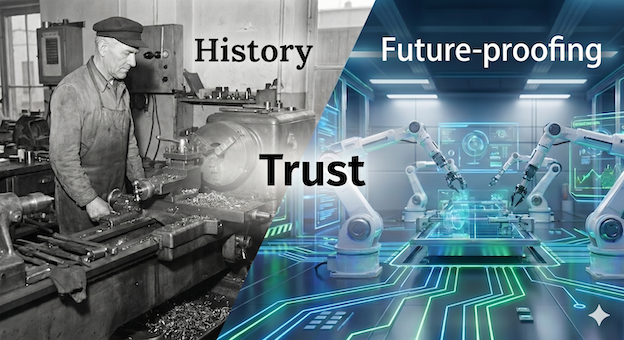
Your “About Us” page is the psychological foundation of your digital presence. If you demonstrate here that your history is the basis for your current innovative strength and performance, you are no longer just some “supplier” — you become a partner.
Stop telling your story. Start proving your expertise at the “open heart” of the business.