Image | AI-generated
The End of Ghost Town Booths Part 3: Structural Messaging – How to Translate Your Technology for the C-Level
C-level executives have exactly two things in short supply at trade fairs: time and any desire to read product catalogs. Yet year after year, B2B tech companies invest massive budgets in elaborate exhibition stands, only to brag about technical features on banners and display screens: “Now with 120% faster signal processing thanks to a novel multiplex architecture!”
The harsh reality on the trade fair floor? A potential customer’s board member walks past that stand, glances briefly at the banner, and keeps walking, completely unimpressed.
Why? Because they aren’t buying signal processing. They are buying reliability, margin growth, or risk mitigation.
If you want to pull real decision-makers onto your stand and engage them in actual dialogue, you need to stop sounding like a technical user manual. You need rock-solid structural messaging.
1. The Pre-Fair Messaging Audit: Moving From Product to Customer Pain Points
Before the booth builder drafts a single sketch, you need a Pre-Fair Messaging Audit. The goal is clear: translate your engineering prowess into razor-sharp market relevance.
Don’t ask beforehand: What can our product do?
Instead, ask yourself: Which top 3 customer pain points do we solve that keep the C-level up at night—and how do we do it better than anyone else?
The translation key from “Engineering Language” to “C-Level Business English”:
- Engineering: “Our sensor measures with a tolerance of 0.001 mm at ambient temperatures up to 500 °C.”
- C-Level English: “We prevent millions in scrap costs when your production is running at full capacity.”
Once you’ve isolated your target audience’s three most pressing financial and operational pain points, build your entire trade fair communication around them.
If you don’t want to leave this translation to chance, you need a reproducible system: In The Translation Workshop Part 2: The Data Sheet Dilemma, I show step by step how to cleanly separate features, advantages, and genuine commercial benefits (FAB) — including a field-tested FAB check for your own data sheets.
2. The Stress Test: Proofing Your Message Before the Fair Starts
Once your top 3 messages are defined, they must pass a two-tier stress test. Only what survives here deserves a spot on your exhibition walls:
Filter A: The “So What?” Test (Competitive Pressure)
Confront your formulated message with a critical team member. After every sentence, they respond strictly with: “So what? Why should I care, and isn’t the competitor over in Hall 4 claiming the exact same thing?” Keep digging until the true, exclusive value is uncovered. When the answer becomes: “Because only our architecture guarantees this level of uptime without costly downtime,” your statement stands.
Filter B: The 7-Second Aisle Test (Time Scarcity)
A board member strolls down the exhibition aisle. They look at your stand for a maximum of 7 seconds in passing. Do they grasp in that single split second:
- Which painful problem is being solved here?
- Why your approach is the only logical choice?
If the viewer has to read three paragraphs of fine print to get the point, your stand has already lost.
3. The Goal: Make the Competition Look Like Amateurs
When you do your homework in the pre-fair audit, the entire dynamic on your stand changes:
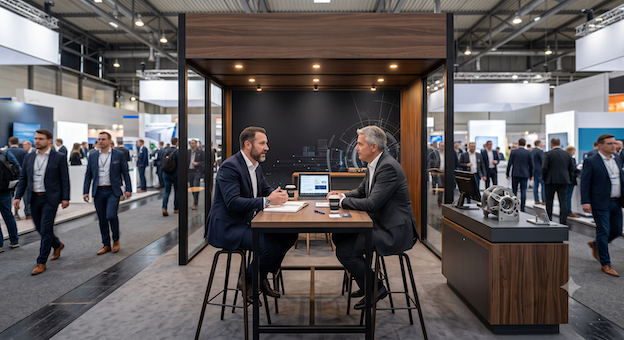
- You no longer hold data-sheet conversations with casual fairgoers, but strategic, high-level dialogues with real decision-makers.
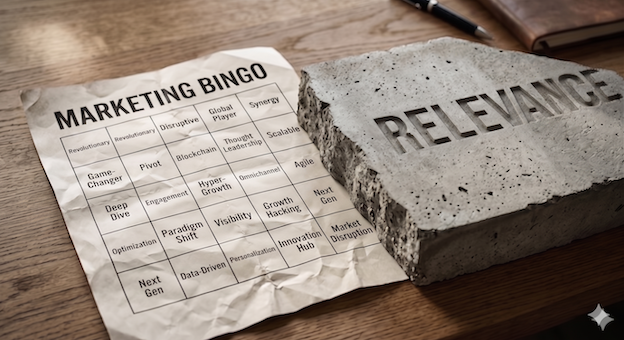
- Your message lands unequivocally: While the competition still plasters interchangeable buzzwords like “Innovative,” “Sustainable,” or “Efficient,” you address the customer’s precise business realities.
A sharpened messaging audit ensures your trade fair stand is no longer just display space, but a magnet for C-level executives.
Coming up in Part 4: Visual Dramaturgy – How your booth design transports your message instead of just looking pretty.