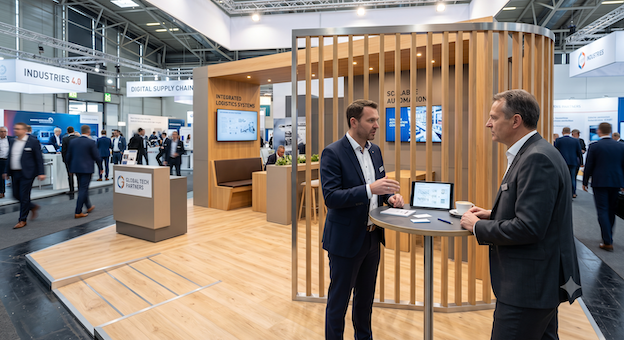
Image | AI-generated
The End of Ghost Town Booths Part 4: Fighting Smartphone Mode – How Your Team and Booth Layout Turn Your Stand into a Resonance Room
You can build the most impressive stand in the entire hall, serve hundreds of liters of gourmet espresso, and set up glowing LED walls: in the end, trade fair ROI stands and falls with the human element, and the physical space supporting it.
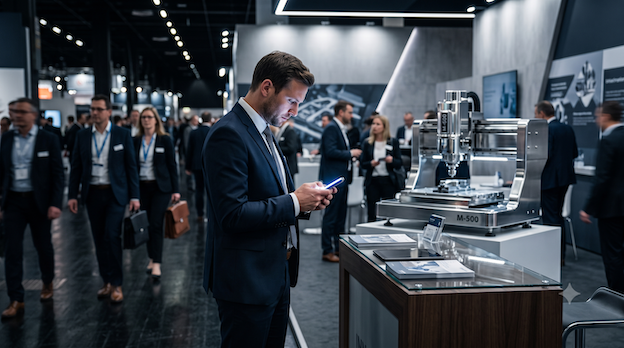
The saddest sight on the exhibition floor isn’t the wrong wall color, it’s stand personnel stuck in smartphone mode. Five team members standing behind the counter, tapping on their screens, drinking coffee, or staring blankly, waiting for a visitor to break the ice.
Operating like this leaves success to chance. The key to a full order book lies in actively guiding both the dialogue and the booth architecture.
1. Spatial Dialogue Architecture: Moving From the Reception Counter to Clear Zones
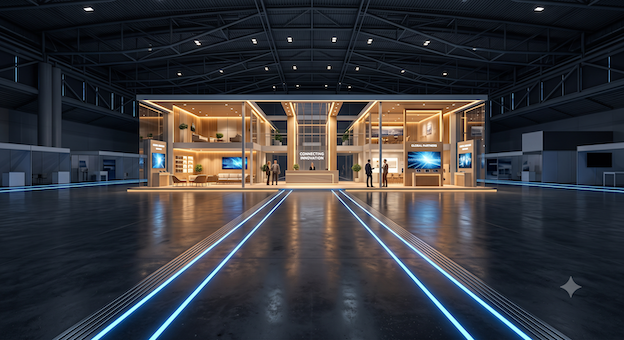
Before the first visitors arrive, physical barriers must be eliminated. Many exhibition stands feel like a fortress: a massive reception counter up front, with personnel waiting behind it like doormen. This deters people — regardless of whether they are board members or engineers.
This is precisely where spatial communication comes into play: true communication goes far beyond traditional PR and press releases, it requires the right physical environment and architectural structure.
A stand designed to create resonance requires deliberate zoning:
- Eliminate the reception barrier: Remove bulky counters at the edges. Open up the space so visitors can glide in without hesitation.
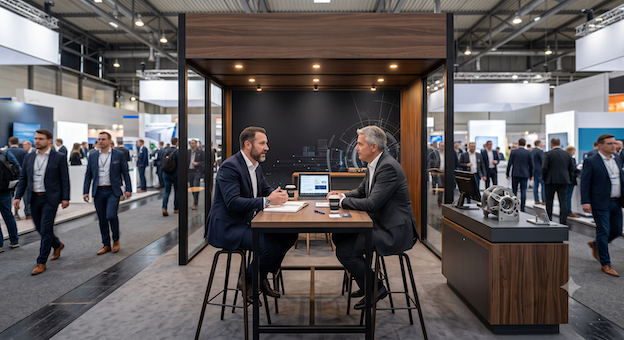
- The screened-off focus zone: Confidentially discussing numbers, strategies, or pain points doesn’t happen in passing amidst noisy hall traffic. Plan for a visually and acoustically shielded corner away from the hustle. An area that exudes calm and explicitly invites deep, undisturbed strategy discussions.
2. Physical and Verbal Triggers: Forcing Passersby to Stop
The exhibition aisle is a one-way street of sensory overload. Visitors walk past stands in a trade fair daze, mentally already at their next appointment. If you wait here for someone to ask, “So, what do you do?”, you’ve already lost.
You need clear triggers to interrupt the subconscious mind of passersby:
- Physical triggers: Position your team at the edges of the stand, not as a barrier, but with open body language. Use exhibits as visual anchors to deliberately draw attention.
- Verbal triggers: Ban the phrase “Can I help you?” entirely. The automatic reflex answer is almost always: “No thanks, just looking.”
Instead, use problem-focused openings directly tied to your Messaging Audit from Part 2:
- Poor opening: “Hello, are you interested in our sensor technology?”
- Strong trigger: “Hello! Are you currently struggling with unplanned downtime due to overheating in your plants as well?”
3. True Interpreter Competence: Qualifying Instead of Handing Out Brochures
Once the conversation gets going, many teams fall into “catalog mode”: rattling off technical features or prematurely handing out brochures. Your team’s objective at the stand is entirely different: they must act as an interpreter between technology and business and qualify the dialogue in seconds.
- No brochures without value in return: Printed brochures are the most expensive waste paper of the fair if handed out unqualified.
- Targeted qualification: Use smart, open questions in the first two minutes to find out if you’re talking to a real decision-maker. If yes: transition from the open stand area straight into your prepared focus zone.
- Translate the need: The team’s job isn’t to explain how a circuit board functions, but to clarify what that technology means for the customer’s bottom line.
Conclusion: From a Passive Ghost Town to a Resonance Room
An exhibition stand doesn’t turn into a crowd magnet through attractive banners alone. Only when the architecture removes barriers, provides space for deep C-level dialogues, and the team sets targeted triggers does a true resonance room emerge: a place that actively compels high-quality business interactions.
Coming up in the last part of the series: The Post-Fair Vacuum – How to Turn Trade Fair Contacts into Real Pipeline and Revenue.